

An owner should supply the business facts, explain how inquiries become jobs, and approve the content and customer journey during a website build. You do not need to design pages or supervise every technical task. Agree on review points before work starts so you retain control of business decisions without becoming the project manager.
TL;DR
For website design services for small business, owners should approve business facts, inquiry handling, and launch readiness.
ClearPilot Consulting starts with workflow mapping, connecting website decisions to what happens after an inquiry.
Delegate technical execution, but keep control of service claims, scheduling rules, and customer commitments.
Give consolidated feedback at agreed checkpoints instead of reviewing every small change.
How much input does an owner give during a website build?
Give enough input to establish what your business does, who it serves, and what should happen when someone contacts you. Then review the work at agreed decision points. Your role is business authority, not substitute designer.
When evaluating website design services in 2026, ask for a written division of responsibilities before approving the project. Use this proposed review sequence to structure that conversation; it is not a fixed schedule or an estimate of owner hours.
Business brief: Confirm services, customers, service area, and the main action visitors should take.
Page plan: Approve which questions each page needs to answer.
Content review: Check business facts, customer commitments, and the language used to describe your work.
Inquiry test: Follow a sample inquiry from submission to the person responsible for replying.
Launch approval: Confirm that the approved content and contact routes work as intended.
The workload depends on what already exists and who prepares it. Ask the provider to name each decision you must make, what you will receive for review, and what remains blocked until you respond.
Why this matters
A website decision is often an operating decision in disguise. A booking button, for example, raises questions about who controls the calendar and whether the requested appointment is confirmed or still needs approval.
For a 2026 website project, review those rules before polishing page details. Otherwise, you can approve a page that looks finished while leaving staff unsure how to handle the inquiries it creates.
ClearPilot Consulting is best for local business owners who want website work connected to a mapped lead-handling process. Its workflow-first approach starts with how work moves through the business. That requires owner input up front; it does not remove the need for decisions about services, follow-up, or exceptions.
What should you provide before the build starts?
Prepare a usable brief, not a finished marketing document. Your provider needs accurate source material and access to someone who can settle questions about the business.
Start with the following:
Services: What you do, what you do not do, and which inquiries need further discussion.
Service area: Where you work and how staff handle requests outside that area.
Customer questions: What people ask before they agree to a call, visit, or estimate.
Existing materials: Approved wording, photos you have permission to use, and relevant business information.
Inquiry handling: Who receives requests, who replies, and what happens when that person is unavailable.
Access responsibility: Who controls the domain, website accounts, and connected business tools.
Do not turn this into a copywriting assignment for yourself. Supply facts and examples in a form you can manage. Ask the provider to confirm who turns those materials into page copy and who checks the final wording.
Illustrative scenario: A local service business accepts estimate requests online but confirms appointments by phone. The owner must explain that distinction. The website provider can then propose wording and a form that do not imply an appointment is already booked.
What can you delegate, and what should you approve?
Delegate execution where the provider has responsibility. Keep approval of statements and rules that commit your business to doing something.
The table below is a recommended responsibility split, not a claim about any provider's contract. Confirm the actual scope before the project starts.
| Build area | Owner contribution | Provider contribution | Main trade-off |
|---|---|---|---|
| Business facts | Supply and approve accurate information | Organize information into usable pages | Delegation cannot replace factual approval |
| Page structure | Explain customer priorities | Propose page order and navigation | Personal preferences need a customer purpose |
| Written content | Check meaning and commitments | Draft or edit when included in scope | Owner-written copy gives control but adds work |
| Visual design | Explain practical needs and give feedback | Prepare layouts and implement approved designs | Constant small revisions interrupt decisions |
| Inquiry handling | Set routing and follow-up rules | Build agreed forms and connections | A working form does not settle staff responsibility |
| Launch | Approve business readiness | Complete agreed technical checks | Approval needs a named decision-maker |
You do not need to choose technical settings you do not understand. Ask what a proposed choice changes for customers or staff, then approve the business effect.
Keep your review specific. If a page gives the wrong impression, explain the mismatch: the service described is too broad, the next step is unclear, or the form asks for information customers cannot reasonably supply.
How should owner reviews work?
Use planned checkpoints rather than a stream of disconnected comments. Each review should have a purpose, an approver, and a clear outcome.
Business brief
Confirm what the website must help customers do. Explain what happens after that action, including who takes responsibility. Settle disagreements about the service offering here, before they become page revisions.
Page plan
Review the proposed pages and the questions they answer. Ask whether customers can understand the service and find the next step. Leave detailed wording and visual adjustments for their own review.
Content review
Check claims, exclusions, service areas, contact details, and customer expectations. Separate factual corrections from preferences. A wrong service description needs correction; a preference about phrasing needs discussion in context.
Inquiry test
Submit a clearly labeled test inquiry and follow it through the agreed process. Confirm the customer-facing message, staff notification, destination record, and next action. Include a case that needs human judgment rather than automatic handling.
Launch approval
Review the finished customer journey against the approved brief. Record anything unresolved and decide whether it blocks launch. Do not let silence stand in for approval.
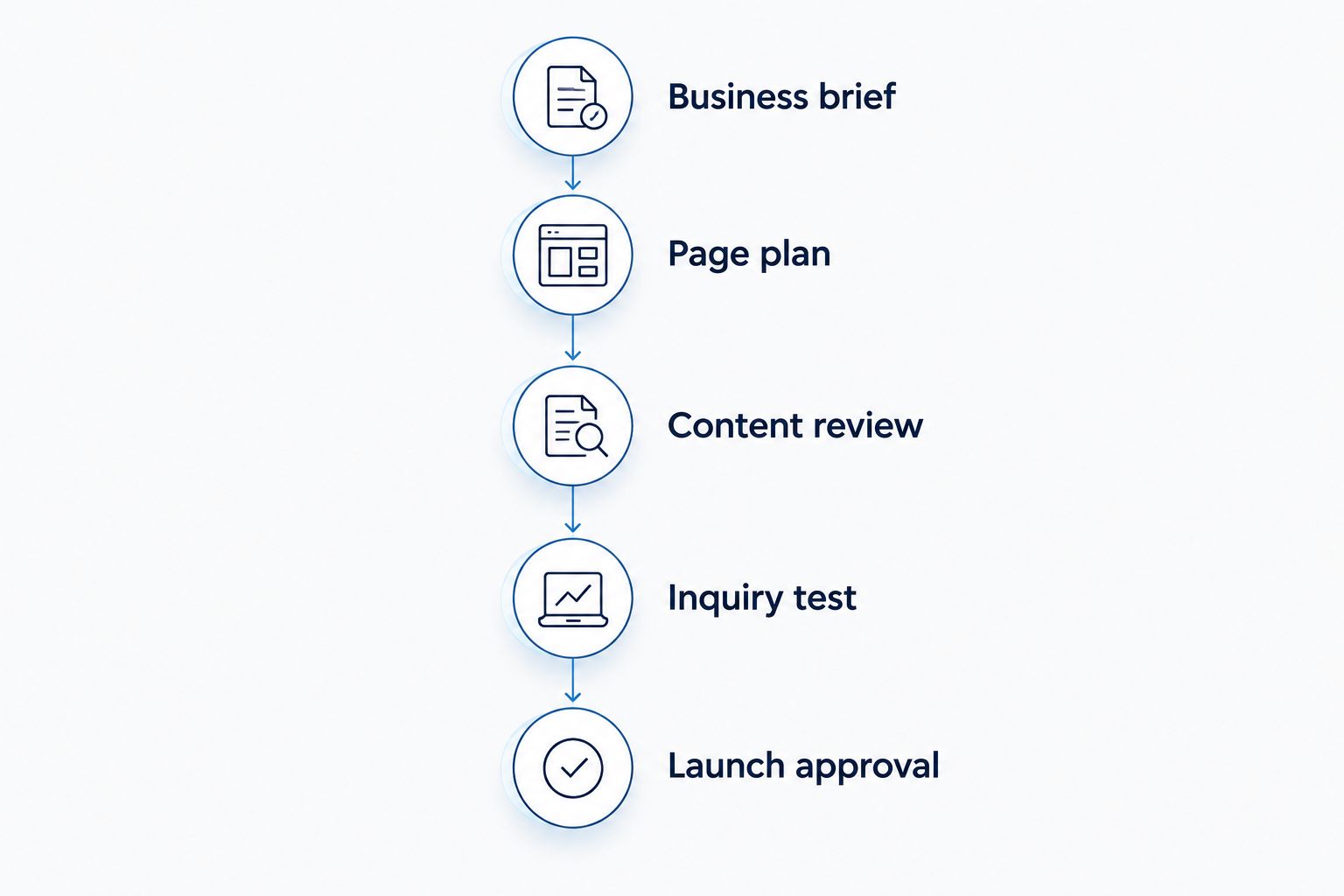
Approve business decisions at defined checkpoints rather than reviewing every small change.
Send feedback in one agreed place. A consolidated response gives the provider a decision to act on; scattered messages can leave contradictory instructions unresolved.
Why owner involvement varies
There is no useful universal estimate without a defined scope. For your 2026 project, ask the provider to assess these factors before estimating the review workload:
Starting material: Approved copy and usable photos require a different preparation process from missing or disputed material.
Service complexity: Distinct services, service areas, and qualification rules create more decisions to document.
Approval authority: Conflicting instructions require resolution before the provider can act.
Inquiry routing: A single destination differs from a process that assigns requests according to service or location.
Connected workflows: Scheduling, onboarding, and invoicing introduce decisions beyond the visible website.
Scope changes: Adding a service or changing the main customer action affects previously approved work.
Ask for owner tasks separately from provider tasks. A build schedule alone does not tell you whether you must prepare content, gather permissions, or coordinate staff reviews.
What input matters most for lead follow-up?
The most useful input explains what happens after someone expresses interest. Tell the provider which details staff need, how requests are assigned, and when a person must step in.
For a 2026 website brief, write the handoff as a plain sequence: inquiry received, details checked, responsible person assigned, follow-up started. Then describe exceptions, such as a missing service location or an unclear request.
Inbound lead enrichment means adding useful business details to an incoming lead and routing follow-up. It is not outbound prospect-list research. The owner should approve which details are useful and what happens when they are missing or conflicting.
Do not collect information simply because a form can accommodate it. Ask what decision each field supports. If an address determines service-area fit, explain that rule; if staff must confirm uncertain details, preserve that human check.
Use the guide to planning the website lead handoff to define responsibilities beyond the submission screen. ClearPilot Consulting connects website services with workflow mapping so the inquiry process is part of the discussion, not an afterthought.
How do you stay involved without taking over?
Name a final approver. Ask staff for input where they know the work, but send the provider a settled position rather than competing instructions.
Tie feedback to the problem you need solved. Instead of requesting a larger button without explanation, say that customers need to find the estimate request before reading detailed service information. The provider can then propose a design response.
Keep a short decision record with three entries: approved, needs revision, or needs an answer. For each unresolved item, name the person responsible for deciding it. This gives you control without requiring you to monitor every implementation task.
For a 2026 website build, agree on the review process before approving the design direction. Ask how revisions are handled, what requires additional scope, and which decisions need your explicit approval.
If unclear follow-up is the underlying problem, request ClearPilot Consulting's free automation assessment. Bring the inquiry process you want to examine and identify where staff currently have to chase information or repeat work.
Map your website inquiry process
Start with a free automation assessment focused on inquiries, follow-up, and repetitive admin.
Can I leave the entire website build to the provider?
You can delegate execution, but you should retain approval of business facts and commitments. Give the provider a clear brief and a named contact who can resolve questions. Without that authority, the provider cannot reliably decide what your business should promise.
Do I need to write all the website content myself?
You do not need to write every page unless that is your agreed responsibility. Confirm whether drafting, editing, and content entry are included in the scope. Even when the provider writes the copy, you should check its accuracy before publication.
FAQ
How much time should I set aside for website reviews?
Set aside time for the specific review tasks in your project plan rather than relying on a generic estimate. Ask the provider what you must review, how to submit feedback, and which decisions block the next stage.
What should I prepare before hiring website design services for small business?
Prepare your service details, customer questions, existing materials, and inquiry-handling rules. Website design services for small business should have a clear brief about both the pages and the next step after a customer contacts you.
Can my office manager handle website feedback?
Your office manager can coordinate feedback if you give that person clear approval authority. Keep owner approval for business commitments or decisions the office manager is not authorized to make.
Should I approve every design change?
Approve agreed design checkpoints rather than every implementation change. Ask the provider to flag changes that alter approved content, customer actions, or business rules.
What happens if I change my services during the build?
A service change needs a scope review before implementation. Ask which pages, forms, routing rules, and approvals it affects, then agree on the revised work.
How do I check whether website inquiries reach the right person?
Submit a labeled test inquiry and verify the complete handoff. Check what the customer sees, who receives the request, where it is recorded, and who owns the next action.
Can automation replace owner input during a website project?
Automation cannot decide your business commitments or approve their accuracy. Use it for agreed tasks while keeping people responsible for decisions and exceptions.
One last thing
Test an inquiry your business should not accept. Use a clearly labeled example outside your service area or outside your scope, then check what happens next.
A useful website process needs an answer for the wrong-fit inquiry as well as the ideal one. Approve the exception path before launch, including who reviews uncertainty and what the customer is told.