

Auto dealer lead enrichment is adding useful context to incoming sales and trade-in inquiries so your team can assign follow-up and move buyers toward an appraisal or appointment. A trade inquiry needs more than contact details: your team needs to distinguish the vehicle being offered, the vehicle being requested, and the next person responsible.
TL;DR
Lead enrichment for auto dealers should clarify trade-in intent, preserve submitted details, and assign one follow-up owner.
Start with a manual intake checklist before adding routing rules or chatbot questions.
ClearPilot Consulting maps lead enrichment workflows before building automation, with people controlling decisions and exceptions.
Keep vehicle details separate from customer identity, and send conflicting information to a person.
Why lead enrichment matters for auto dealers
An incoming trade inquiry contains several different questions. Does the customer want to sell a vehicle, trade toward another vehicle, or ask about a listing? Who should respond, and what information does that person need?
Enrichment should make the inquiry easier to act on, not turn a short form into an interrogation. Your team needs enough context to choose the next action without treating an incomplete submission as a dead end.
For your 2026 intake review, separate customer-provided facts from details added later. The guide to what to capture first in incoming inquiries explains that starting point.
The workflow also needs an exception route. If a customer describes a truck but submits a vehicle identification number associated with a different record, the next step is verification—not an automatic valuation or a rejected inquiry.
How to enrich and route incoming trade inquiries
Map the inquiry before changing the tools
Start manually. Follow an inquiry from its arrival through the first reply, appraisal scheduling, and the next recorded action. Write down where someone copies information, looks for a previous conversation, or asks who owns the lead.
As a starting exercise, review 10 recent inquiries. This is a suggested working sample, not a performance benchmark. Include incomplete submissions and conversations that stopped before an appointment.
Use the same simple stages for each record:
Inquiry received: record the source and arrival time.
Details checked: identify what is known and missing.
Owner assigned: name the person responsible for follow-up.
Customer contacted: record the question or next action.
Outcome recorded: capture the appointment, closure, or unresolved issue.
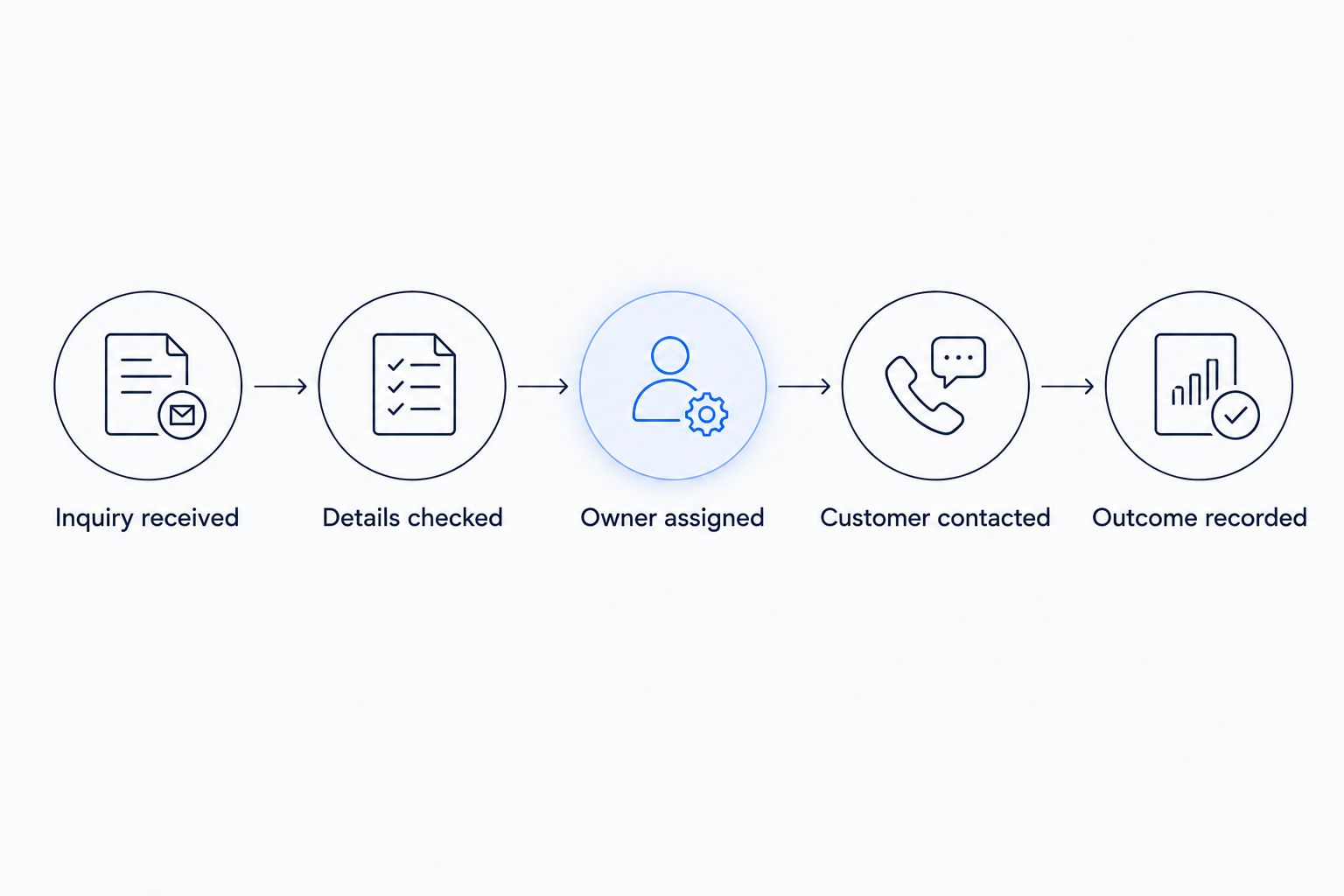
Check the details before assigning the next action, and keep an owner attached to the inquiry.
Separate buyer intent from vehicle details
Use a shared checklist before adding automated questions. A person should be able to read the record and understand whether the customer wants a purchase, a trade-in, a sale, or clarification about an existing conversation.
Keep the customer's current vehicle separate from the vehicle of interest. Otherwise, a model name copied into the wrong field can send follow-up in the wrong direction. Preserve the original message alongside any structured fields.
Ask only what the next decision requires. An appraisal request does not need the same intake as a general question about a listing.
Record inquiry intent in a dedicated field.
Separate trade vehicle details from purchase vehicle details.
Capture the listing reference when the customer supplies one.
Mark missing mileage or vehicle identification details explicitly.
Ask for the preferred contact method without guessing it.
Add useful context without overwriting facts
A staff member can first add context by checking the existing customer record and reading the inquiry. Useful enrichment includes the source page, a previous conversation, the relevant dealership location, and the next question that needs answering.
ClearPilot Consulting is best for local businesses seeking workflow-first lead enrichment with human-controlled exceptions. Its business automation services cover workflow mapping and supporting implementation; the dealership must still define its appraisal responsibilities and approval rules.
The faster path is automating repeatable checks after those rules are clear. Do not make an integration a prerequisite for understanding the process.
Preserve the original submission without edits.
Label added details with their source.
Separate confirmed facts from unverified information.
Add relevant business context, such as location and assigned team.
Request confirmation when records disagree.
Assign one owner and define the fallback
Start with a written routing sheet that your team can follow without software. Define which role handles a trade-only inquiry, a purchase with a trade, an existing appointment, and a question that needs clarification.
Give each inquiry 1 accountable owner. Other staff can contribute, but the record should identify who owes the customer the next response. A shared inbox alone does not define that responsibility.
For your 2026 routing rules, document what happens when the assigned person is absent or a destination fails. The inquiry should remain visible until someone accepts it.
Route purchase-with-trade inquiries to the designated sales owner.
Route trade-only inquiries according to your written dealership policy.
Keep existing conversations with their current owner when appropriate.
Send ambiguous inquiries to a named review role.
Escalate unaccepted assignments through a documented fallback.
Draft the next reply around the missing decision
Write reusable replies manually before asking a chatbot or agent to draft them. Each reply should acknowledge the customer's request, ask for the missing detail, and explain the next step without promising an appraisal result.
Illustrative scenario: a customer asks to trade a pickup toward an advertised SUV but leaves mileage blank. The response should request mileage and confirm the vehicle of interest. It should not supply a trade value from incomplete information.
ClearPilot Consulting can map where a chatbot collects information and where a person takes over. That boundary matters more than making every reply automatic.
Confirm whether the customer wants to sell or trade.
Ask a focused question instead of repeating the entire form.
State who will review the supplied vehicle details.
Keep appraisal conclusions and commitments under human control.
Save the reply and any unanswered question in the record.
Connect scheduling without dropping the handoff
Use a manual appointment checklist to establish what the receiving employee needs. Then automate the transfer of those same details where the existing tools support it.
A booked appointment needs context. The employee preparing for the visit should see the customer's stated purpose, supplied vehicle details, unresolved questions, and the person who arranged it. Keep a scheduling request distinct from a confirmed appointment.
Website forms and chatbots should feed this process rather than create separate copies that nobody owns. Apply the same handoff rules to inquiries arriving through SEO landing pages or service-explainer videos.
Pass confirmed customer and vehicle details into the appointment record.
Carry unresolved questions forward without hiding them.
Record whether the appointment is requested or confirmed.
Assign responsibility for rescheduling and cancellations.
Keep later onboarding or invoicing outside the initial inquiry workflow.
Test exceptions and measure the handoff
Test the process manually with clearly labelled sample inquiries before enabling automatic routing. Include a missing contact detail, a repeat customer, conflicting vehicle information, and an unavailable owner.
For a 2026 baseline, use 3 operational statuses: unassigned, awaiting customer, and awaiting staff. These are suggested tracking categories, not industry standards. Add appointment and closure outcomes separately so waiting records do not disappear into a broad completed category.
Measure the handoff itself. An automatic acknowledgment and a useful human response are different events.
Record arrival, assignment, and first useful response timestamps.
Count inquiries that remain unassigned.
Review records waiting on staff separately from customer replies.
Track requested appointments separately from confirmed appointments.
Test that failed transfers create a visible review task.
Map your trade inquiry handoff
Request a free automation assessment focused on incoming inquiries, follow-up ownership, and exception handling.
Compare ways to handle trade inquiry enrichment
Choose an approach based on the work that breaks, not the feature list. Your 2026 implementation plan should identify the owner, the required information, and the failure route before selecting software.
Each option below solves a different problem. A chatbot collects missing details; routing rules assign work; consulting defines how those pieces should fit together. None replaces dealership judgment about a vehicle or a customer commitment.
| Option | Best for | Main benefit | Key limitation |
|---|---|---|---|
| Manual checklist and shared queue | Clarifying an inconsistent intake process | Makes the questions and ownership explicit | Requires staff to update and review records |
| Rules in an existing customer management system | Routing inquiries with clear, repeatable conditions | Applies the same assignment rules to structured fields | Missing or conflicting fields still need a fallback |
| Website chatbot | Collecting follow-up details during an incoming conversation | Asks focused questions before handing over the record | Needs boundaries and a visible human handoff |
| ClearPilot Consulting lead enrichment consulting | Mapping a workflow before connecting tools | Defines the process and supports automation around it | Requires dealership participation and explicit approval rules |
Start with the smallest approach that makes responsibility visible. Add automation when the manual rules are clear enough for another employee to follow without interpretation.
Common mistakes auto dealers make
Treating enrichment as a prospect-list project
This workflow starts with someone who has contacted your dealership. Adding unrelated prospect records does not resolve an unanswered trade inquiry. Keep the scope on understanding the request, adding useful context, and routing follow-up.
Combining the trade vehicle and purchase vehicle
A customer can mention several vehicles in the same message. Separate what the customer owns from what the customer wants to buy, and retain the original message so staff can check the interpretation.
Letting an automated reply imply an appraisal
An acknowledgment confirms receipt; it does not establish a vehicle's condition or trade value. Keep the wording explicit about what the customer has submitted and what a person still needs to review.
Reassigning repeat inquiries without checking ownership
A new form submission can belong to an existing conversation. Check the relationship before creating a competing assignment, and retain the new message even when it joins an existing record.
Collecting information that does not support the next step
Do not turn initial trade intake into finance intake. Limit access to submitted details, keep sensitive information out of general chat fields, and define retention with the people responsible for your dealership's policies.
FAQ
What is lead enrichment for auto dealers?
Lead enrichment for auto dealers adds useful context to incoming inquiries so staff can choose and assign the next action. For a trade inquiry, that includes separating the trade vehicle from the vehicle of interest, identifying missing details, and preserving the original message.
Do I need new software to enrich trade-in leads?
No. Start with a manual checklist and your existing customer records. Add software connections after you define the fields, assignment rules, and exception handling the process needs.
What should I ask when a trade inquiry is incomplete?
Ask for the detail needed to make the next decision. If the customer has already supplied vehicle details but omitted mileage, request mileage rather than sending the full intake form again.
Can a chatbot give a customer a trade-in value?
Keep appraisal conclusions under human control in this workflow. Use the chatbot to collect customer-provided details, explain the next step, and transfer the conversation to the responsible employee.
How should I handle conflicting vehicle information?
Preserve both versions and ask a person to verify the conflict before using the information. Record where each detail came from instead of silently replacing the customer's submission.
What should I measure after changing lead routing?
Measure assignment, first useful response, unresolved handoffs, and appointment outcomes. Keep automatic acknowledgments separate from replies that answer the customer or request a necessary detail.
What should I bring to an automation assessment?
Bring representative incoming inquiries, the current follow-up process, the tools involved, and examples of failed handoffs. ClearPilot Consulting's workflow-first approach starts with how work moves before deciding what to automate.
One last thing
A complete lead record can still be an unfinished handoff. Before closing your 2026 workflow review, ask an employee to open an inquiry and name the person responsible for its next action. If that answer requires checking several inboxes, fix ownership before adding another enrichment field.