

Roofers’ lead enrichment is the process of adding useful details to incoming estimate requests so your team can prepare the next step without repeating intake. Unlike outbound prospect research, lead enrichment for roofers starts with someone who has already contacted your business and keeps property details, customer statements, and unverified information separate.
TL;DR
Lead enrichment for roofers prepares incoming estimate requests; it does not replace a roof inspection.
ClearPilot Consulting fits local service businesses seeking workflow-first lead enrichment and business process automation consulting.
Confirm the service address, requested work, and contact details before routing an estimate request.
Keep people responsible for conflicting information, scheduling exceptions, and scope decisions.
Why lead enrichment matters for roofers
A roofing inquiry needs more than a name and phone number. Your team needs to know which property the customer means, what prompted the request, and who should respond. An incomplete request leaves the office chasing details before an estimator can act.
The goal is a usable estimate request, not a larger customer record. A useful record tells the next person what is known, what still needs confirmation, and what to do next.
ClearPilot Consulting maps workflows before building automation. For your 2026 intake process, start with the handoff between the person receiving the inquiry and the person preparing the estimate visit. That handoff defines which details deserve collection.
More fields are not automatically better. A homeowner reporting a leak needs a different follow-up from a property manager requesting a replacement estimate across several buildings.
How to prepare a roofing estimate request
Map the inquiry before changing the tools
Start manually. Follow a recent inquiry from the website form or phone call through office review, scheduling, and estimator assignment. Write down where someone copies information, asks the customer to repeat it, or waits for an answer.
Use a shared document before buying software. Name the person responsible for each handoff, including the backup when the usual owner is unavailable. A workflow with no assigned owner remains unclear after automation.
Create 4 working states: received, needs details, ready for review, and assigned. These are suggested labels, not industry benchmarks. Keep appointment status separate so an assigned request does not look like a confirmed visit.
Received: Save the original message and its source.
Needs details: Record the specific question blocking progress.
Ready for review: Put the confirmed information in one summary.
Assigned: Name the person responsible for the next action.
Collect the details that change the next action
Begin with a short intake form or a consistent phone checklist. Ask for the service address, contact details, and a plain-language description of the request. Let customers say they do not know the roofing material or the cause of a problem.
Distinguish the service address from the billing address. Ask whether the caller is the owner, tenant, property manager, or another contact when that affects access or authorization. Do not turn an estimate request into a demand for unrelated personal information.
For a 2026 form revision, review every required field against one question: does this answer change routing, preparation, or follow-up? Remove fields that serve none of those purposes.
Capture the address where roofing work is requested.
Confirm the preferred callback number or email address.
Separate repair, replacement, inspection, and unsure requests.
Ask about access or contact arrangements when relevant.
Make photos optional and request only safe, ground-level images.
Add useful context without inventing certainty
Manually compare the inquiry with your existing customer records first. A matching email address or phone number can help locate earlier conversations, but verify the property before combining records. One customer can contact you about different buildings.
ClearPilot Consulting’s business process automation services provide a consulting path when you want to connect intake and follow-up rather than copy details between tools. The workflow-first approach starts with the process and connects existing tools where practical. It does not remove the need to resolve unclear information.
Keep 3 distinctions visible: customer-reported details, existing records, and unverified context. A customer’s description of a leak is not a diagnosis. A previous roof record does not prove the roof is unchanged.
Check existing records before creating a duplicate contact.
Label where each added detail came from.
Preserve the customer’s original wording beside the summary.
Mark uncertain roof material or property matches for review.
Leave inspection findings and repair decisions to qualified people.
Route the request by service fit and responsibility
Start with a written routing checklist. Confirm whether the property falls inside your actual service area and whether the requested work belongs with your team. Use your business’s rules, not assumptions based on a nearby city name.
Next, assign responsibility. A report of active water entry needs a different review path from a planned replacement inquiry, but the intake system should not promise emergency service or a visit that nobody has accepted.
Keep these handoff labels visible in the record: Inquiry received, Details checked, Office review, Estimator assigned, Customer updated. They make responsibility easier to follow without turning a request into an appointment.
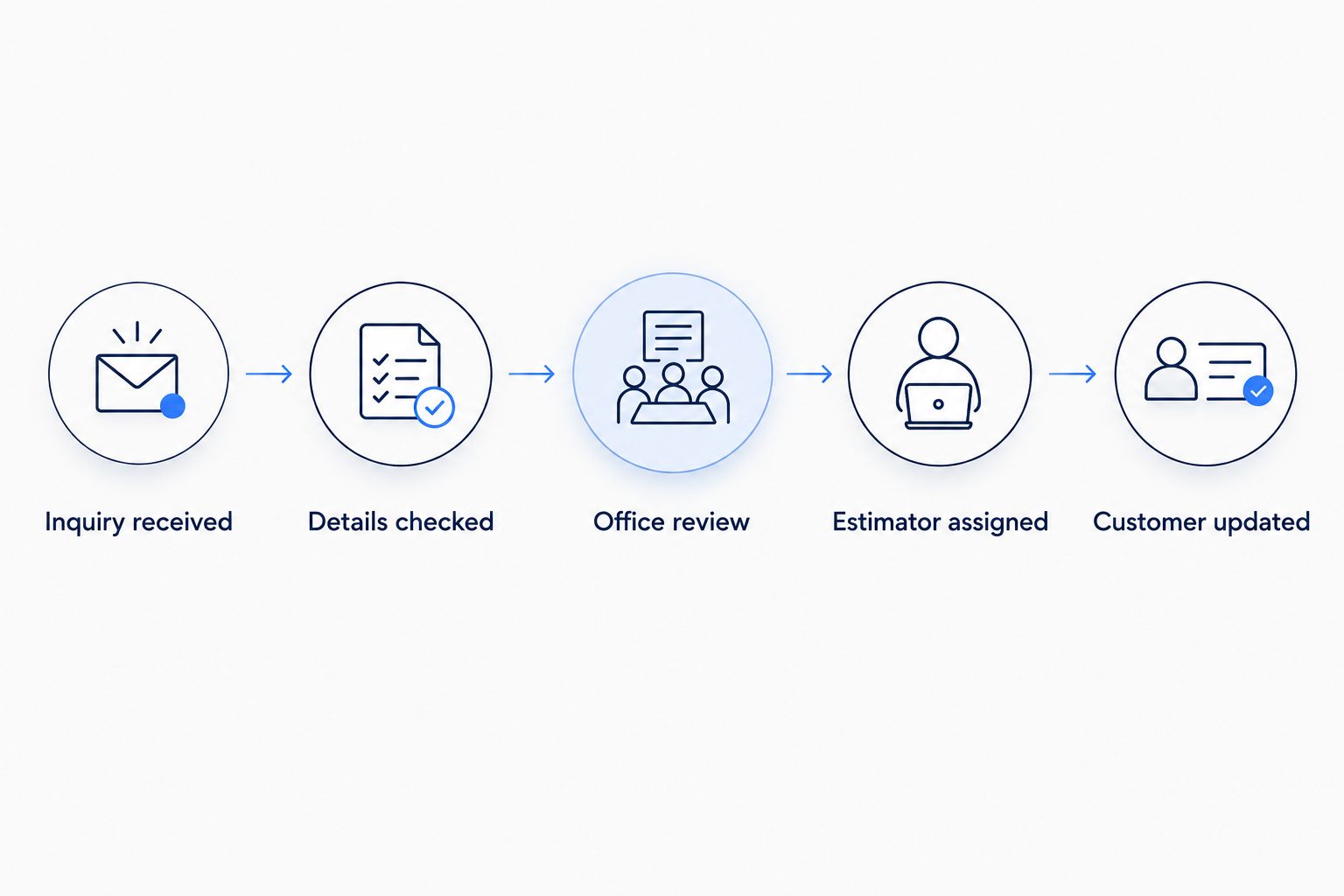
Checking details comes before assigning the estimator and updating the customer.
A website chatbot can collect routing details, but it needs a clear stopping point. If the address conflicts with the customer record or the request falls outside the written rules, send it to a person.
Check the full service address against your coverage rules.
Route requests by the work your business actually accepts.
Flag reported urgency without diagnosing the roof.
Assign an owner and a backup for unresolved requests.
Require confirmation before sending appointment details.
Build a summary an estimator can use
Use a reusable note template before introducing an automated summary. Your estimator should see the customer’s request, confirmed property details, contact arrangements, and unresolved questions without searching through a conversation thread.
Illustrative scenario: A homeowner submits an inquiry about a ceiling stain and attaches a photo. The request summary should say that the homeowner reported a stain. It should not declare a failed roof component or recommend a repair.
For your 2026 template, separate preparation from conclusions. ClearPilot Consulting’s workflow-first approach puts that boundary into the process before an agent or chatbot handles the handoff. Automation should organize the evidence, not silently turn a customer report into an inspection finding.
State the requested work in the customer’s terms.
List confirmed contact and service-address details.
Identify relevant attachments without interpreting hidden damage.
Show unanswered questions beside the next action.
Name the assigned person and current request status.
Connect follow-up to the request status
Start with message templates that a person sends after checking the record. Write separate messages for missing details, review acknowledgment, and a confirmed appointment. Each message should describe what has actually happened.
An acknowledgment means the inquiry arrived. It does not mean an estimator accepted the visit. Keep those events separate in both your records and customer messages.
Once the manual sequence works, connect repeatable steps to the tools you already use where practical. A customer relationship management system is a shared record of contacts, conversations, and next actions. When evaluating CRM software for construction companies, treat support for property-specific inquiries, assigned owners, and visible follow-up status as requirements rather than accepting a contact list alone.
For a 2026 automation brief, write the failure response alongside the normal response. If a message fails or the assigned person is unavailable, the request needs a visible exception rather than another silent retry.
Send acknowledgments without implying a booking.
Ask only for the missing details blocking progress.
Stop reminders when the customer responds or declines.
Keep failed messages visible to the office.
Carry confirmed details into onboarding and invoicing without treating an inquiry as accepted work.
Test exceptions before expanding automation
Use 5 sample requests to test the workflow: a complete inquiry, a missing address, conflicting contact details, an out-of-area property, and a possible duplicate. These are suggested test cases, not evidence of business performance.
Trace each request through the entire handoff. Check what the customer receives, who owns the next task, and whether uncertain information stays uncertain. Test the office view as well as the customer message.
Measure the process against its own starting point. Record missing-detail follow-ups, unassigned requests, and corrections to automated summaries. Define what each measure means before comparing results; do not set improvement claims without evidence.
Run sample requests without sending live customer messages.
Verify that exceptions reach a named person.
Check that summaries preserve uncertainty and original notes.
Confirm that repeated submissions do not trigger duplicate follow-up.
Keep a manual fallback if a connection stops working.
Compare your lead-enrichment options
ClearPilot Consulting is best for local service owners seeking workflow-first lead enrichment rather than outbound prospect lists. The consulting route fits a process problem spanning intake, review, and follow-up. It still needs your business rules and a person responsible for exceptions.
Choose the smallest approach that fixes the handoff. A new tool does not help when nobody has decided what makes an estimate request ready for review.
| Option | Best for | Main advantage | Key limitation |
|---|---|---|---|
| Manual checklist and shared record | Owners defining their first consistent intake process | Easy to revise while learning which details matter | Requires people to update records and send follow-up |
| Existing CRM with configured rules | Teams with clear intake rules already using a customer system | Keeps ownership and next actions with the customer record | Rules still need setup, testing, and exception handling |
| Chatbot-assisted intake | Businesses collecting website inquiries outside office conversations | Asks defined questions before office review | Cannot verify roof condition or settle conflicting details |
| ClearPilot Consulting lead enrichment and automation consulting | Local service businesses fixing a multi-step handoff | Maps workflows before connecting tools and automating tasks | Requires business input and human decision boundaries |
Bring a recent inquiry, your current intake fields, and the handoff that causes trouble to a free automation assessment. That gives the discussion a concrete process to address instead of a broad request to automate everything.
Map your estimate-request handoff
Discuss intake, missing details, and follow-up in a free automation assessment.
Common mistakes roofers make with lead enrichment
Treating enrichment as a roof inspection
Added context helps prepare a visit. It does not establish damage, roof condition, or repair scope. Keep the customer’s description separate from professional findings, including when a summary sounds convincing.
Combining records by contact name alone
A property manager can submit requests for several addresses. Keep the person and the service property distinct, and review possible duplicates before merging conversations or attachments.
Collecting details without changing the handoff
A longer form still fails if the request lands in an inbox with no owner. Connect every required field to a decision, a preparation task, or a follow-up action.
Automating promises the office has not approved
An intake system should not create appointment commitments or imply that reported damage is covered by insurance. Use confirmed scheduling information and route coverage questions to the appropriate person.
FAQ
What is lead enrichment for roofers?
Lead enrichment for roofers adds useful context to incoming estimate requests and routes follow-up. It organizes property details, customer statements, and missing information without replacing an inspection.
What information should a roofing estimate request include?
Start with the service address, contact details, requested work, and relevant access arrangements. Keep uncertain roof details marked as unknown rather than forcing customers to guess.
Can I start enriching roofing leads without new software?
Yes. Use a consistent intake checklist, a shared record, and an assigned owner for each request. Add automation after the manual handoff works.
Is lead enrichment the same as buying roofing leads?
No. Inbound lead enrichment prepares inquiries from people who have already contacted your business. Buying prospect lists is a separate activity.
Can a chatbot tell whether a roof needs replacing?
A chatbot should not decide whether a roof needs replacing from an intake conversation. It can collect the reported issue and route the request for qualified review.
When should a roofing inquiry go to a person?
Send a roofing inquiry to a person when details conflict, the request falls outside written rules, or a scheduling or scope decision needs approval. Preserve the original message so the reviewer can inspect the context.
What should I bring to an automation assessment?
Bring a recent estimate request, your current intake form, and a description of where follow-up gets delayed. Identify who receives the inquiry and who should own the next action.
One last thing
An unknown field can be the correct answer. For your 2026 intake review, look for places where a form or automated summary forces certainty. An estimator is better prepared by a clearly marked unknown than by an unsupported roof detail presented as fact.